
THE LIGHT: From BFS, to Completing Mozart Masterpieces
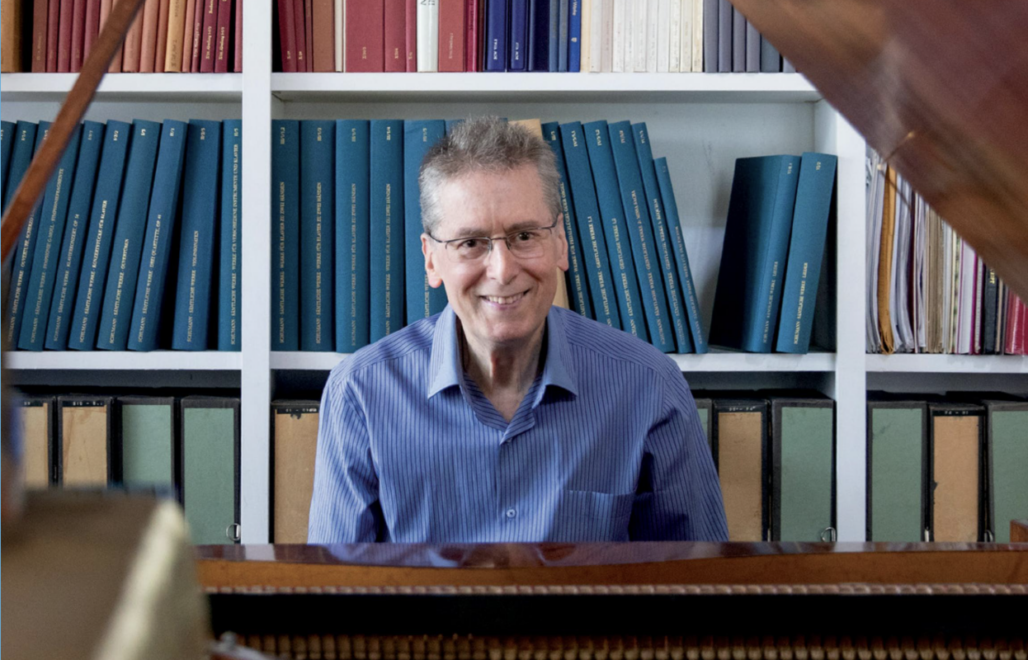


Few musicians have dared to step into the creative space once occupied by legendary composers, such as Wolfgang Amadeus Mozart and Johann Sebastian Bach. It would be like matching wits with Albert Einstein, or challenging Lebron James to a game of one-on-one. Who, among us, would be so bold? The answer: a pianist, composer, and scholar of formidable range, who has achieved something extraordinary in modern classical music, he has restored the performer’s right—and responsibility—to create.
As a young boy, Robert Levin always had a thing for music. When he was as young as two-years-old, he was not going to sleep to the sounds of nursery rhymes, but instead was singing an aria from Mozart’s Don Giovanni, as well as showtunes from South Pacific for his father. So they got Robert’s Uncle Ben—a musician—involved.
“He tested me, and realized that I had absolute pitch, which is the ability to identify a note when played on an instrument or song without knowing what key it’s actually in,” Robert remembered. “So at that point, my uncle decided that he would take my education in hand, and sought out teachers for me.”
Robert continued to grow up in New York City and study music on the side, and in 1963, transferred from I.S. 59 in Springfield Gardens, Queens, to Brooklyn Friends School for ninth grade. “My father’s first cousin, Dr. Bernard Benjamin, who was the chief of pediatrics at Brooklyn Jewish Hospital, had two children who had gone to a Friends school. So he recommended to my parents that I go to a Friends school because he felt that it had a very beneficial effect on his son,” Robert said. “To a large extent, the most precious kinds of experiences that I encountered at Brooklyn Friends School had to do with the superb faculty that was teaching there. … Of course, another aspect inevitably of being in a school with small classes was the intensity of interpersonal relationships, and to this day I remember the names of a lot of my classmates without any difficulty whatsoever.”
One of those classmates, in fact, was a young lady, who was also a musician. “I had quite a crush on her in grade nine, and I wrote a piece for her for flute and piano as a matter of fact,” Robert said. “I don’t think we ever played it, but I discovered it when I moved back to the States after living in Europe.”
Following tenth grade, Robert—who very much wanted to stay at BFS—was swayed to take his talents across the pond. Before leaving, however, in the margin of his final BFS report card, his advisor innocently wrote: “Robert excellent pianist.”
“My ear training teacher was a French American named Louis Martin, who studied in Paris under French music teacher and composer, Nadia Boulanger,” Robert said. “Louis said to my parents, ‘look, you know, he’s going to make progress here in New York, because he’s got a gift, but if you want him to take giant steps forward, then there’s only one address, and that’s for him to go to France and study with Nadia’.”
That moment ended Robert Levin’s academic time at Brooklyn Friends School, but launched the man who would become one of the most prolific classical pianists of our time. Nowhere is that illustrated more than when he was asked to complete one of the most well-known unfinished works by Mozart—the Requiem, by acclaimed German musician and composer, Helmuth Rilling. However, when he was asked to do the unthinkable, Robert turned Helmuth down.
“I looked at him and told him that I am the wrong person to ask to do this, because I come from the wrong country, and I have the wrong surname. I mean, think about the fact that an American Jew is going to finish a Catholic mass for the dead.” However, Rilling would not take no for an answer. “For the next two or three years, the man pestered me on the phone. He always seemed to know where I was,” Robert joked.
Finally, he gave in, and finished the master’s great work. When it was performed in Germany for the first time in 1991, Robert Levin sat nervously in the audience.
“You know, the Germans don’t scream and yell at the end of performances. They are rather low key. But they applauded loudly and for a long time. … The response by the audience was pandemonium.”
Over the past three decades, Robert has gone on to complete more of Mozart’s unfinished works, as well as pieces by the likes of Bach and Schubert. As a performer, he has regularly improvised cadenzas in Mozart, Beethoven, and Haydn concertos, reviving a practice that had virtually vanished from modern performance. These improvisations—constructed spontaneously before live audiences—embody one of Levin’s greatest achievements: the reintroduction of improvisation as an essential, historically grounded element of classical music-making.
Beyond the concert stage, Levin’s influence has been profound as an educator and thinker. At Harvard University and in masterclasses worldwide, he has reshaped how musicians understand authorship, interpretation, and authenticity.
Still, he looks back on his days at Brooklyn Friends School as a major moment in his journey. One of his greatest memories was being in the Meeting House on Schermerhorn Street, sitting in silence. “The meditative character of communing together in Meeting established the essential spiritual dimensions to our education there, that we weren’t simply being trained in standard academic disciplines, but the deepening of contemplation was something that was central to our exposure. That is something I carry with me to the present day.”